Wine

Have the ingredients in wine changed over the years? Certainly the size of wine glasses have changed. I remember setting the table in the 1960s for my Mom’s dinner parties, and the wine glasses would have held maybe 3 oz of wine. The water goblet stemmed glass back then would still be smaller than a current size wine glass. Now at restaurants we get offered so many glass sizes from 3 oz to 12 oz, I got confused this summer when I first noticed the options. What happened to one size of glass and one accepted pour of a glass of wine? Now we will have so many ways to drink ourselves into we aren’t really drinking. “Oh well officer, I only had one glass of wine. Well yes it happened to be 32 oz, but it all fit in this beautiful glass my host provided.” 

So back to the ingredients. A bottle of wine used to be somewhat rare. Mom and her friends would offer wine at dinner, and guests usually had a glass, maybe 2, but again, the glasses were small. I remember chianti wine Mom bought in the straw wrapped bottle, a wine she bought for a spaghetti dinner party. Afterwards we used the empty bottle as a candle holder and lined them up on the dining room wall ledge.

And wine was a specialty item, specialty beverage, not an everyday occurrence or choice. Wine took time to produce, bottle and age.  It was not mass produced. Yet now we have box wines and box stores that sell wine. How do we keep up with the demand with only so many grapes, growers and the need to allow wine to age? Well ingredients. What speeds up the wine aging process?

This isn’t a wine making column so I have no idea, but my body reacts differently to wine than it used to react. Some might be my age, rather than the wine’s, yet I do suspect we artificially age wine in some parts of the world, and that affects the body. Other than sulfites, we don’t get to know the ingredients and amount in our wines. Maybe there are more or different kinds of sulfites now?

I was told wines from France or Italy, the original wine making countries, still make wine closer to the original “recipe”. I’m sure the best ones are considered expensive so I may not have tried them, but generally good wines won’t leave an aftertaste or heavy head feeling (even with just a 6 oz glass) or a low feeling the next day. A good wine, certainly a white, to be feels crisp, clear with a real grape taste. Due to volume offered for sale everywhere, to expedite such a mass of wine, we must be  adding man made chemicals and ingredients to get wine ready, bottled and on the shelf within weeks versus years.

Regardless I am sad something artificial has been added to wine, and that many of us feel it even if we haven’t pinpointed it. In wine culture we’ve moved from corks to screw caps to boxes. It can be mind boggling when we grew up to have a certain reverence and protocol for the treatment and care of wine, from the aging process to pouring. Or has wine just become more accessible and my taste buds are just off? Or maybe it’s my 20 oz glass….

Glasses

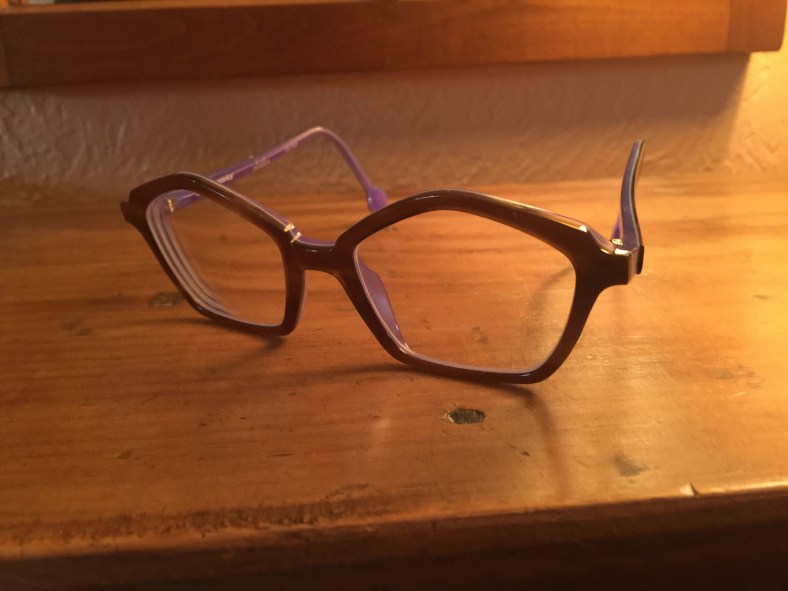
I hadn’t realized how good I looked without my glasses. Meaning, if I don’t have my glasses on when I look in mirror I appear better to myself than with them on.  I didn’t fully realize that until lately, with my new prescription glasses. When I tried on the frames in the store, naturally they are just plastic lenses so one has to get close to mirror to figure out if the frames suit. Yet one gets the general sense of it, whether the frame shape and color work with one’s face. And good to get a second opinion.

So today I tried on my new glasses. As I really looked at the glasses and myself I realized  this image seems more detailed and lined than this morning. What happened to the softer version I’m used to seeing? I need glasses for farsightedness so I rarely wear them at home. I guess I rarely see myself through the  corrected vision. Actually a photograph is the only other way and I guess few of those are close ups.

No doubt others have more experience with my face than I do. They’ve seen the changes occur over time, and are familiar with how the lines and skin move when I’m animated or still. I don’t. I know what it feels like to be on the inside looking out, or what age I may or may not feel on any given day.  The face in the mirror is changing and today I saw it more clearly and in more detail. Granted my face was just looking, not animated. A face has beauty when it has life and is expressive, which most of us don’t see in ourselves, in those real authentic moments when we are out in the world, living and being.

Change is life. I remember my Uncle saying when he was in his late 80s, that he felt he was the same person inside. He felt the same as he always had throughout his life, yet when he caught sight of himself in the mirror he was shocked, like “Who is that old guy?”  What he saw in the mirror got farther and farther from how he still felt inside.  I can imagine now how that could be.  Part of Uncle’s approach was to avoid mirrors.

I feel like my spirit and heart benefit from the longer I live as I have more time to be in quest mode, and grow, practice and become aware. That can feel like a lightness in my heart and spirit. I am much lighter in my heart than I was 30 years ago, hands down. The physical self responds differently to time and gravity.  I remember hearing “Youth is wasted on the young”. I think they meant the physical body part of youth.

Maybe I’ll just continue without my glasses when I look in the mirror, or embrace all the changes life brings, loving what is. Or do both. Probably best to do both.

How Many Acts?

Earlier I’d written about our lives divided into 3 acts, like a play, and the third act makes sense of the first two. That was from a book Jane Fonda wrote. It was the first I’d heard of that description, and I found it an interesting consideration.

Now there’s a documentary coming out on Fonda’s life. It refers to the Five Acts in her life, reorganizing the film material into an act for her father and each of  her three husbands, with the fifth being her relationship with herself. At 81 she claims she never felt better, and is grateful for each step and act that led her to this moment.

I recently returned from visiting my mother, who celebrated her 95th birthday. The night I arrived, she told me she had watched a show and in the discussion about the book The Power of Now. The interview covered how our strong reactions or negative interpretation of what people say may actually be coming from how we think, and not necessarily what they mean. And we can have body pain associated with that.

Mom went on to describe a personal example and how watching this show helped her to  decide to change her behavior. She could see how her reaction got in the way of meeting new people in her retirement village. WOW. She called it a teachable moment, the student was ready to learn. I guess this conversation amazed me and warmed my heart. In the days that followed I experienced her changed reaction in some of our dealings, what sometimes could be defensive, now felt loving. Ahhh like a beautiful breeze.

So how many acts in life do we experience I wonder? Life and living look different from the generation before. The path ahead isn’t forged. It unfolds.

And we have some mighty ageilicious women sharing their way.


Being Inspired

Some of us “over 60’s” were talking about how inspiration and hope come from different sources now. Who doesn’t want to feel excited by an idea, person, or situation? And at this age, many of the things that excited or inspired us we have already accomplished, and that feeling of firsts isn’t there either. We’ve had our first kiss, first job, first car, first home etc etc. We also have enough experience in certain areas like the complicated work project we survived, that we don’t need more of it. We have learned, so it doesn’t provide that level of inspiration of a new opportunity. Or at least not for me.

I’ve delved into many kinds of projects, productions, relationships, travel and work cultures in the past 4 decades,and taken risks of many sorts to learn about work, love, and life. My path and question now seems to be, and often has been I suppose, is what is the new spark that I can ignite for myself that includes my desire for purpose and a feeling of contribution?

What sparks us over time may change. Or maybe due to our own growth over our lives, naturally the spark or what sparks us will have to be different? We can’t necessarily come back to something later that excited us and find it again. I think opportunities come to us at specific times in our lives, like certain jobs, travel, relationships, family choices etc. Either we act on them or we do not. Time marches on. Going back isn’t always possible, and the way the world is changing, we might not find that exact place again anyway. (Yes I know some folks go looking for their high school sweethearts decades later, find them and marry. I imagine that is a good spark.)

I’ve learned that some folks love to keep busy even if it is just to be in motion. Maybe they are bored, so being on the move, even to the shopping mall, can feel like something is happening versus feeling antsy, confused, or seeking. I can appreciate doing something to shift one’s mood. I do it too sometimes, but if I feel I’m using it to distract myself from my feeling, especially a feeling of wanting focus/purpose/spark, then I do choose quiet vs activity as a way to hopefully gain insight.

It is possible creative people, and innovators, people in pursuits that require their creativity to make something new from scratch, often find themselves in periods of inspiration, implementation, rest and restless. To use a farming analogy, it is like a cycle we go through; composting, fertilizing, planting, harvesting and then laying fallow for a while. Then it starts again.

Often when I’m in that fallow stage I wonder if I’m done with inspiration or being able to find that something new feeling. That’s how it can hit me in that moment, that this is the feeling from now on.

Yet as a younger person, I would feel that way after an inspired period, the idea or plan was implemented and completed. After that large effort, like the land, it seems important to allow ourselves to embrace these stages of life’s growth, including replenishing our energy, trusting the fallow stage, imagining something good will emerge from it like being inspired by a new thing. It can come. We just need stay open to the possibilities. It is a process. May we be patient and enjoy this new territory.

If Mom had a T-shirt…

My feisty mom, who just turned 93, and has been a vegetarian since the late 1970’s, said to me, the T-shirt I really want would say, “If I’d known I was going to live this long I wouldn’t have taken such good care of myself.” I’m guessing you’ve heard of the other T-shirt saying.

Mom is feisty, has her full faculties, though naturally slowing down, has aches, pains, a walker, but she lost a lot of her friends 10 or more years ago.So I guess that is what she means. Her good health has her living longer, yet with fewer of her good friends around.

And to age deliciously, having friends of various ages and interests is what keeps us all curious and engaged. I have introduced Mom to a lot of my friends, and they have a peer-like relationship in terms of conversations. Mom can’t run around with them or reciprocate in some of the same ways, yet having a glass of wine and repartee is something she does.

Of course, each phase of our life, every decade for each of us, feels different in some way I imagine. Either we are building a career and family, so that’s our focus. Or social issues and being of service to help make the changes we wish for ourselves and our communities, can be a focus. And then maybe our body claims our attention with its lack of wellness, and that takes center stage.

I must say, now at 60 I feel like I’m 30, or how I’d want to have felt at 30 in terms of self acceptance and wellness. I might have achy feet in the morning, but that just helps me feel grounded in my first steps to open the curtains, then it dissipates.

I feel for Mom and the frustrations of a body not doing what it used to be able. I am glad she shares with me what is happening as it helps me to know and understand. Yet for awhile, when I was helping her through surgery, doctor appointments and moving, I started to identify with her journey, her worries, her limitations and felt they were my own.  Yet  seeing the documentary “Advanced Style”  which profiles several saucy fashionistas in NYC,  some over 90 years old, who hadn’t given up, still had a zest for life, fashion, beauty, and style I felt enlivened. They weren’t done til they’re done. That inspired me as I felt like I had been in waiting-mode versus fully living and engaged.  I got my kickstart, which maybe is what my T-shirt should say.

(Link to Advanced Style http://www.advanced.style)

Is Aging Well an Art Form?

With baby boomers now past middle age (generally those born between 1946-1964) how are we aging compared, to say , our parents? It seems to me, as a child, any adult seemed old to me, almost like the fun of their life was over. As school kids, we expected mothers and fathers to be staid, not have too much fun, nothing new was going to happen to them, and they’d sit around a lot. Or that is picture in my head.

So now those in our 50s, 60s, 70s, well to me, we all seem younger than our parents were at the same age. And maybe because fewer of us had children in the baby boomer group, does that make us more youthful seeming? Forever young, or youthful? Or not having child worries delays us of a few wrinkles and grey hairs? Anyway, it seems my baby boomer cohorts are constantly exploring new ways to think, be, and participate. Be it new hairstyles, trips, jobs, homes, trainings, marriages, cars, opportunities…it’s new new new! Yes, the world is different, and the challenges we face are different. Yet also we don’t accept that aging need to be grey perms and polyester.

I can’t say necessarily we are in better health than our parents. Many of my friends have had serious illnesses, much of it related to stress and worry which maybe we have more. I lost some friends early, and we do talk about our aches and pain laments. Interesting we may have more health challenges earlier (or do we?) yet seem younger in our lifestyle and pursuits. Or maybe there are more choices we face, plus we have to adapt, because staying with the same company, mate, or even the same predictable way of doing things (think technology) is no longer a sure thing, as it seemed more the norm with our parents’ generation.

Certainly the way parents ready their children for what to expect in each phase of their life is to share their experience with them. Yet for our generation, and maybe each one behind us, I’m not sure our hands-on experience will translate well, as some of the jobs and possibilities that younger people will face, don’t exist yet, and we haven’t seen them.

Maybe this is where the art form comes in, when we can be open to ambiguity and the unknown, and trust we will know what to do and do it well, when the opportunity presents itself.

Act 3

A lot of us are reflecting on the idea that we are in the “Act 3” of our lives, the Act that can make sense of the first 2. Like a play, when the final act brings all the elements together. It kind of is a nice way to reflect on it, as it still leaves the door open for more to come, and more with meaning. Plus in our 50s and 60s we are generally healthy, vibrant and still have more to give, but probably in a different way. And that is what we need reflect upon.

Age-ilicious Podcasts Coming

Today Maureen and I started recording a couple of conversations on Aging Deliciously or Aging Luciously (depending on your spell check:). We thought having a back and forth conversation as a beginning point to share and explore with others what it is like and can be like living and aging at this wild and wonderful time in our western culture.  
Stay tuned so we can let you know how to find and listen to them. 

Happy Delicious Aging my friend.


The Art of Conversation

Who knew that having a conversation with a group of passionate, smart, wise people in a 12 person circle together would lead to energy lifts, laughter and sometimes a changed opinion? It seems so simple really, yet I rarely am part of a lengthy, engaging, dynamic conversation. How can I learn and consider another point of view if I’m not listening, participating based on what is said, and considering different opinions? Maybe because these conversations aren’t competitive, but rather truly engaging we can hear better.  Anyhoo, at these Conversational Salon party gatherings, someone picks a topic they want to host, and those interested show up to chat and listen for a couple of hours. And each topic, we tie into Aging deliciously too.

One of the most lively for me was the topic of Rites and Rituals and the place in our lives. We talked of the big ones like funerals and weddings, and some unique family traditions that could be considered rituals. I don’t have many rites or rituals in my life these days, but I shared a personal ritual I held, my morning journalling. To me it is a special, maybe a sacred act that I find grounding and positive. I guess that explains why I’ve been journalling for about 25 years. Actually it is one of the few, consistent things I have ever done. Well that, and brushing my teeth .

Each morning I walk my dog, then make a pot of tea and journal in my notebook. This is the start of each day, and if it isn’t my day might be somewhat off. No matter where I am, this is my ritual. It stabilizes me, makes sense of my thoughts, and generally lifts my spirits. So when I shared this as an example of my ritual,  someone said, ” As important and as sacred as journalling and tea drinking may be to you, that is yours and yours alone. So I’d call it a routine. A sacred routine but it’s not a ritual.  A ritual usually involves more people or it might be done alone, yet the actions are ones others also do, like a vision quest. There would be specific, understood steps and requirements that must be followed.”

I at first was miffed. I thought to myself, “What? My ritual wasn’t a ritual?” Yet as I continued to listen to other comments, and the conversation deepened, expanded, and was full of listening and responses, by the end of the night I was able to say, ” Based on the conversation, I agree that my journalling isn’t a ritual, but I don’t think of it as a routine either. I would say it is a sacred practice, some days more sacred than others, but a mindful, deeply important practice.”

So I had reconsidered a long held view that I never would have contemplated reconsidering without a thoughtful conversation. Maybe that contemplation is part of moving through the ages deliciously. 

“Knowledge spea…

“Knowledge speaks, but wisdom listens.” ~ Jimi Hendrix

“There is no innovation without insight and there is no insight without reflection.” ~ David Rock

“We must listen with a willingness to be changed.” ~ Alan Alda

“Optimism is a choice in spite of evidence to the contrary.” ~ Joel Henning

“God grant me the serenity to accept the things I cannot change, courage to change the things I can, and wisdom to know the difference.” ~ The Serenity Prayer (Reinhold Niebuhr)