The Five L’s for Living Well

Dr. Gladys McGarey is a holistic doctor, author, and advice giver when asked. Currently she can be found on Youtube answering the common question of “if you could tell a younger person anything what would it be?” McGarey is now 104 years old and still excited by life and her purpose. She has written about the 5 L’s for a long and happy life: Life, love, laughter, labor and listening.

Life itself: “As you pay attention to life itself, life is like a seed. It has a shell around it. It has all the energy of the universe within it,” says McGarey. But life can’t change for the better without being activated by us first.
Love: “Love is the activating factor. It cracks the shell,” she says. “It’s the whole aspect of life as we come into it and take our first breath.” Love feeds into the remaining aspects of what makes life meaningful.
Laughter: “Laughter without love is cruel. It’s mean [and] cold,” McGarey says. “But laughter with love is joy and happiness.”
Labor: “Labor without love is drudgery. ‘I gotta go to work’ or ‘They’re too many diapers,’” she says. “Labor with love is bliss. It’s why a singer sings, why a painter paints, why I became a doctor. It’s what juices you up. It’s what makes you really know: ‘This is who the inner core of me is.’” Pay attention to what drives you, she adds.
Listening: “Listening without love is empty sound,” says McGarey. “But listening with love is understanding.” When you’re able to find people who understand you and what your purpose is, life becomes more fulfilling and you can go on to do the same for others.

According to McGarey, really until our last breath these 5 L’s remain the key to living fully and well. Check her out on youtube. She’s got a beautiful braided crown of hair as she gestures excitedly about living with love, light and purpose.

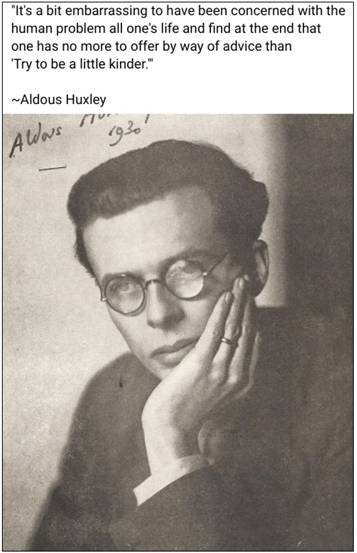
Aldous Huxley Quote

What’s the expiration on wisdom shared? Coming across a quote from prolific author, philosopher and pacifist Aldous Huxley these words seem to hold up in terms of relevance no matter where in time humans may find themselves. Huxley died in 1963 at the age 69, having written more than 50 books including “Brave New World”. He seemed to be endlessly curious and contemplative, with a broad range of interests over his lifetime such as mysticism and universalism.

Sharing Life Lessons

In reading a quote from Olympic coach LaTanya Sheffield, her coaching philosophy is “Share all of the life lessons and wisdom that you have.” She was talking about the athletes she works with and her daughters, yet it seems it could apply to any aspect of one’s life. Maybe we don’t think what we have to share is wise, or even a life lesson, but there are things that having more years of experience can be helpful to those a minute or two behind us on this life journey.

Maybe it is a short moment between you and a stranger. The person shares something about a challenge they are having, and you have a perspective that might prove helpful. We don’t mean offering a lecture or being bossy pants but rather how it is broached and received, this can be the act of sharing life lessons we have with those who might benefit. And by benefit we mean, if years ago someone had shared with us that same wisdom, might we have saved ourselves some grief, suffering or time? Or just not felt so alone? Perhaps all we “gain” by sharing is to ease someone through a difficult moment, and then we move on. Maybe it helps, maybe they do think about our words. Or maybe we are building capacity with another/others through a longer “relating ship”.

A life lesson is earned and can be a gift to pass along. It seems a person may not know or have perspective on their own dilemma or goal. They may be swimming in confusion, angst or overwhelm. Certainly they may not have the bird’s eye view a more experienced or wiser soul might see. If we can see something, and say something relevant, it just may be the lift or insight needed because those confused or “in it” at the moment might not know what is going to help. It can be a gift delivered and shared.

Are We Sure?

It seems the idea of conversation, and it’s importance is a theme here of late 🙂 Ramona, a reader, left a comment about “Fierce Conversations”, and with Maureen’s gift of that book, it has sparked this post.

Author Susan Scott of “Fierce Conversations” believes that all of our relating, be it at work or in our life, is done through one conversation at a time. Whether we are direct or careful, fully say what is on our mind, or tip toe, each conversation builds on the one before, and that is our relationship. Scott gives examples of those who just nod yes at the work meeting because the boss doesn’t take well to disagreement, yet that can lead to dire consequences for a business because no one person has the full perspective, able to see from all angles. Or someone having their head in the sand so to speak, and many others can see it, are frustrated by it, but say nothing knowing it won’t be well received.

For any of us, the idea of keeping an open mind, and to not assume our point of view is right, that is a practice many of us are challenged to do. Or may not be aware we do it. No matter our good intentions or open minded beliefs, when presented with an uncomfortable exchange, be it small or large, our habit may be to seek safer ground. Maybe we keep our voice quiet rather than explore this different point of view. The truth for each of us might seem obvious and for us has held up over time. Yet, Scott says, whatever we are sure of, don’t be. Naturally, we want to be sure of things, and life is gentler when we are agreed with or not shown something we ignore or don’t want to consider. Yet how will we be different or how will the world be the change we say we want if we aren’t open to honest conversations, meaning really sharing what is the truth in our head we don’t often say out loud? If we are careful with people because we know the emotional landmines and limits, are we learning or growing or stretched in any significant way? To some of us, this may matter, to others maybe not?

This seems a time on our earth we need to have more fierce conversations. This means to speak our truth rather than our habit to avoid the uncomfortable with our loved ones or work colleagues . It seems being willing to share our real points of view, and to hear others in a mutual way, our conversations will be more about relating, and getting to the heart of the matter for ourselves and those we come in contact. And that seems a cleaner and healthier way to live. Otherwise we end up with the consequences of all the less than fierce conversations we have had, because we couldn’t bring it up. And often then there is suffering. Maybe our’s. Maybe their’s. Maybe both.

So, whatever we are sure of, don’t be. Let’s be open to consider we don’t know or may not be right. Maybe we get fiercer, more honest so that our relationships are more connected and honest and we can act on that clarity. There is a kind way to delve and bring things up, and in doing so, it shifts old habits and lifts old burdens. Even if the answer is I don’t know or I haven’t thought about it, Scott asks, well if you did know, what would you answer or if you had thought about it…just ways to not let it drop or allow people to cop out. Not easy, but a new lens to consider.

The Benefit of Conversation

Ruptures or difference of opinion in a conversation can actually strengthen our human connection when we also repair them.

Here’s a quote from Dr. Perry page 256 in his 2023 co-authored book “What Happened to You?”

Conversation promotes resilience; discussions and arguments over family dinners and mildly heated conversations with friends areas long as there is repair–resilience-building and empathy-growing experiences. We shouldn’t be walking away from a conversation in a rage; we should regulate ourselves. Repair the ruptures. Reconnect and grow. When we walk away, everybody loses. We all need to get better at listening, regulating, reflecting. This requires the capacity to forgive, to be patient. Mature human interactions involve efforts to understand people who are different from us. But if we don’t have family meals, don’t go out with friends for long, in-person conversations, and communicate only via text or twitter, then we can’t create that positive, healthy back-and-forth pattern of human connection.

Conversation of this sort seems to take practice, particularly to stay with it when it might get really uncomfortable. How many of us stick around? Or know how to? More and more it can feel risky to say what we really mean or is on our mind, even to express innocent curiosity about something. Depending on how well we know someone could influence what level of risk we would want to take in a conversation. Hmmm, does this seem a different dynamic and consideration for us in 2024 than 5, 10 or 15 years ago?

If we have had an experience with someone and had ruptures of understanding, but stayed with it to do the repair, then the relationship grows and is stronger for it. We can strengthen ties to one another in real time, with face-to-face exchanges as a means to develop deeper human connection and understanding. The desire for repair needs to be mutual, yet that mutuality is a beautiful thing, truly. Are we missing out on having meaningful conversations in our day-to-day/week-to-week lives? A good conversation experience can be enlivening, energizing and connecting. Now who doesn’t want some more of that?

Advice to our younger selves?

What would you say to your younger self from your perspective now? What does it feel like to be your age in this moment? Does it surprise you? Below are some interesting questions, with over a 1000 interviews so far, with people from around the globe sharing what it feels like to be their age. It started with the interviewer wanting to learn if there were any common threads or advice one could glean as a younger person from those 60, 70, 80, 90, 100 years old. What could an older person share or impart on the younger ones? The interviewer is now including people of all ages to reflect on how as they age does it feel compared to earlier ages. Is now what they imagined it might feel like to be their current age? Are there wisdoms to share? Lessons learned that are universal? Do we learn from others or do we need to learn it for ourselves firsthand?

Here is one of many clips available on utube provided by the same interviewer. It seems many of us share this curiosity of lessons learned as we age. Deliciously 🙂

Stories Hold Our Cure

Rewatching Australian comedian Hannah Gadsby’s 2018 Netflix special “Nanette”, her content seemed full of obvious head-nodding truths. Originally though, it seemed shocking, edgy and uncomfortable for some of us. Thankfully we’ve had 6 years to digest and consider her stories, observations and experiences. Each of us may have stirred it in with other information or sources we’ve encountered over the years on the topics of gender, history, and power. In Hannah’s case part of her story includes growing up in a small town in Tasmania, where it was illegal to be gay. Realizing she was gay she describes ways that impacted her sense of self and how the outside world treated her.

In this special, she is choosing to reframe her life experience for herself and the audience. In 2018 this was a rare and direct approach. Six years ago Hannah takes a large risk (as did Netflix?) , willing to quit comedy to speak her truth and reframe her story, which she does with earnestness and challenge.

Hannah’s storytelling rings true throughout the hour, including these final gems:

Connection is what we all need.

Stories hold our cure.

Laughter is just the honey.

May we connect through our stories and add lots of honey.

Winter Experiences

If we live in a place that enjoys a change of seasons, then the winter that we experience holds it’s own special pleasures for us. As it is February, we are fully into winter. Some may be playing in the snow, enjoying the outdoors. Some may have traveled away from cold and snow. Those living in these darker winter months might feel puzzled by the desire to tuck-in and hunker down with a book or tackle an indoor project that needs attention. Maybe we have a “hibernating” inclination , wanting to stay more in our “cave” and be less active. And it actually feels good, and fills us up in a different way.

Tucking-in or hibernating as part of our winter experience can be a natural and healthy choice. Like a piece of farmland or a garden, the soil cannot be active, fertile and producing all year long. It needs to lay fallow, to take time to recoup before Spring, to be ready for the planting of new seeds. Like that soil, humans need to take time to recoup, tuck-in more than go out, maybe ponder and plan. In that way it helps us be re-energized for new activity and “seed planting” possibilities for the Spring ahead.

Pondering

As we embark on a new year it can be a nice time to slow down, take stock and perhaps through our reading, watching something or conversations, we may find new ideas we want to ponder. Maybe we get a thought-provoking comment from another person or book that inspires us for the months ahead.

In rereading The Wheel of Life by Dr. Elisabeth Kubler-Ross, there were some stand out wisdoms she shared at the end of this, her final book. Dr. Elisabeth spent the majority of her life and practice being with and learning about death and dying while finding the beauty and love in it all.

In 1997 she wrote that the planet is in trouble, and mankind has wreaked havoc on mother earth.

Page 284 : ” I believe Earth will soon correct these misdeeds. Because of what mankind has done, there will be tremendous earthquakes, floods, volcanic eruptions and other natural disasters on a scale never before witnessed…and enormous casualties suffered….How else can people be awakened? What other way is there to teach respect for nature and the necessity of spirituality?”

Based on her lifetime of professional and life experience she believed she learned what matters most to those passing on. Some of her thoughts include:

You cannot heal the world without healing yourself first.

The hardest lesson to learn is unconditional love.

Everything is bearable when there is love.

My wish is that you try to give more people more love.

The only thing that lives forever is love.

It seemed Dr. Kubler-Ross wanted to underscore this message for us all as her parting gift:

The sole purpose of life is to grow. The ultimate lesson is learning how to love and be loved unconditionally.

Resist or Yield

When faced with a stressful, uncomfortable or tragic situation, we may have a habit to resist it or yield to it. Another way to think of it or feel it, we may contract; physically tighten ourselves or close-in as a way to feel protected. Over time our bodies may hold that contraction and that can lead to body pain. Or we might breathe deeply, open ourselves up and expand into this scary unknown; in a sense, yield to it.

The following excerpt from Eckhart Tolle’s book “A New Earth” seems worth sharing. Do we contract or expand? Resist or yield?

Whenever tragic loss occurs, you either resist or you yield. Some people become bitter or deeply resentful; others become compassionate, wise and loving. Yielding means inner acceptance of what is. You are open to life. Resistance is an inner contraction, a hardening of the shell of the ego. You are closed. Whatever action you take in a state of inner resistance (which we could also call negativity) will create more outer resistance, and the universe will not be on your side; life will not be helpful. If the shutters are closed, the sunlight cannot come in. When you yield internally, when you surrender, a new dimension of consciousness opens up. If action is possible or necessary, your action will be in alignment with the whole and supported by creative intelligence, the unconditioned consciousness which in a state of inner openness you become one with. Circumstances and people then become helpful, cooperative. Coincidences happen. If no action is possible, you rest in the peace and inner stillness that comes with surrender. ”

xoxoxox